We have a new paper out in Annals of Glaciology! This is an invited contribution as part of a special issue in the Annals entitled ‘New Cryospheric Research Directions from IGS Global Seminars’.
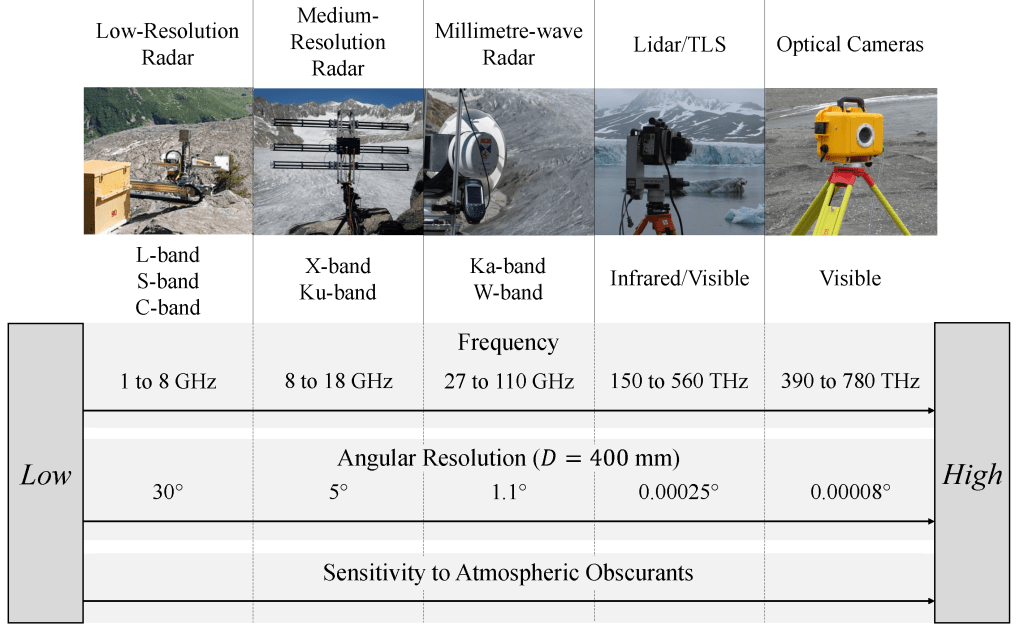
In our paper, we discuss the benefits of using real-aperture radar systems operating at 94 GHz for glacier mapping. We place an emphasis on the use of real-aperture systems as opposed to Synthetic Aperture Radar (SAR) systems because they do not suffer from the same sensitivities to atmospheric variability that phase-based SAR systems do.
We show through theoretical calculations that operating at 94 GHz leads to an improvement in imaging resolution compared to lower frequency radars whilst also being able to penetrate through bad weather conditions. It’s shorter radar wavelength also means it is sensitive to changes on a glacier surface which suggests variability in ice surface conditions could be mapped.
We conclude with a set of future research directions: 1) assess the capabilities of 94 GHz radar to monitor glaciers of different dynamics and sizes; 2) collect 94 GHz radar backscatter measurements from a range of ice surface types; 3) improve real-aperture 94 GHz radar processing workflows; and 4) improve the practical deployment of 94 GHz radar systems in the field.
You can read the full paper here.

 Research Page: William D. Harcourt